Career guidance
Build More Than Skills — Build Your Professional Profile
Prepare your practical work and your professional profile together, so you can show and explain what you have built.
- Build software you can demonstrate.
- Explain your work clearly in profiles and interviews.
- Use accurate evidence without inflated claims or job guarantees.
From learning to applying
Your Career Preparation Journey
- 1Learn programming
- 2Build development skills
- 3Learn full stack
- 4Build real projects
- 5Use AI responsibly
- 6Build GitHub
- 7Prepare resume
- 8Improve LinkedIn
- 9Create job profiles
- 10Practise interviews
- 11Search and apply
Four steps between a finished project and a first application
- Step 01
Build evidence
Complete a guided project inside your track with code you wrote, reviewed and understand. Use it as evidence of the work you actually completed.
Read guidance - Step 02
Shape your profile
Turn that work into a resume, GitHub and LinkedIn profile that describe what you actually built, in language a recruiter can follow.
Read guidance - Step 03
Practise explaining
Work through coding, SQL, API and debugging questions, then rehearse your project until you can answer follow-ups without a script.
Read guidance - Step 04
Apply and follow up
Search with the right role keywords, apply to openings that match your current level, track responses and close the gaps rejections reveal.
Read guidance
This is preparation and guidance, not placement. We do not promise jobs, guarantee interview calls or make claims about hiring partners.
Guidance topics
Detailed Career Preparation Guides
- Resume Preparation
Your Resume Should Clearly Show What You Can Build
Present your education, technical skills and project work in a format that is easy for recruiters and applicant systems to understand.Read guidance - LinkedIn Profile Guidance
Build a LinkedIn Profile That Reflects Your Skills
Treat LinkedIn as part of your professional identity, with clear evidence of what you are learning and building.Read guidance - GitHub Profile Guidance
Show Recruiters What You Have Actually Built
Use GitHub to make your practical work visible, organized and understandable.Read guidance - Job Portal Profile Guidance
Make Your Job Profiles Easier for Recruiters to Understand
Build complete, accurate profiles on Naukri, Indeed, Foundit and other relevant fresher platforms.Read guidance - Job Search Strategy
Don’t Just Apply More — Apply Smarter
A focused job search connects suitable roles, honest skill matching and consistent preparation.Read guidance - Technical Interview Preparation
Practise Solving, Debugging and Explaining
Prepare beyond memorized answers through coding, SQL, API, frontend, backend and project-based questions.Read guidance - HR Interview Preparation
Communicate Your Story Clearly and Honestly
Build confidence for professional conversations without relying on scripted or misleading answers.Read guidance - Project Explanation Preparation
Don’t Memorize Your Project — Understand It
Learn to explain the problem, the architecture and your contribution as a connected engineering story.Read guidance
Choose a career path, not only a trend
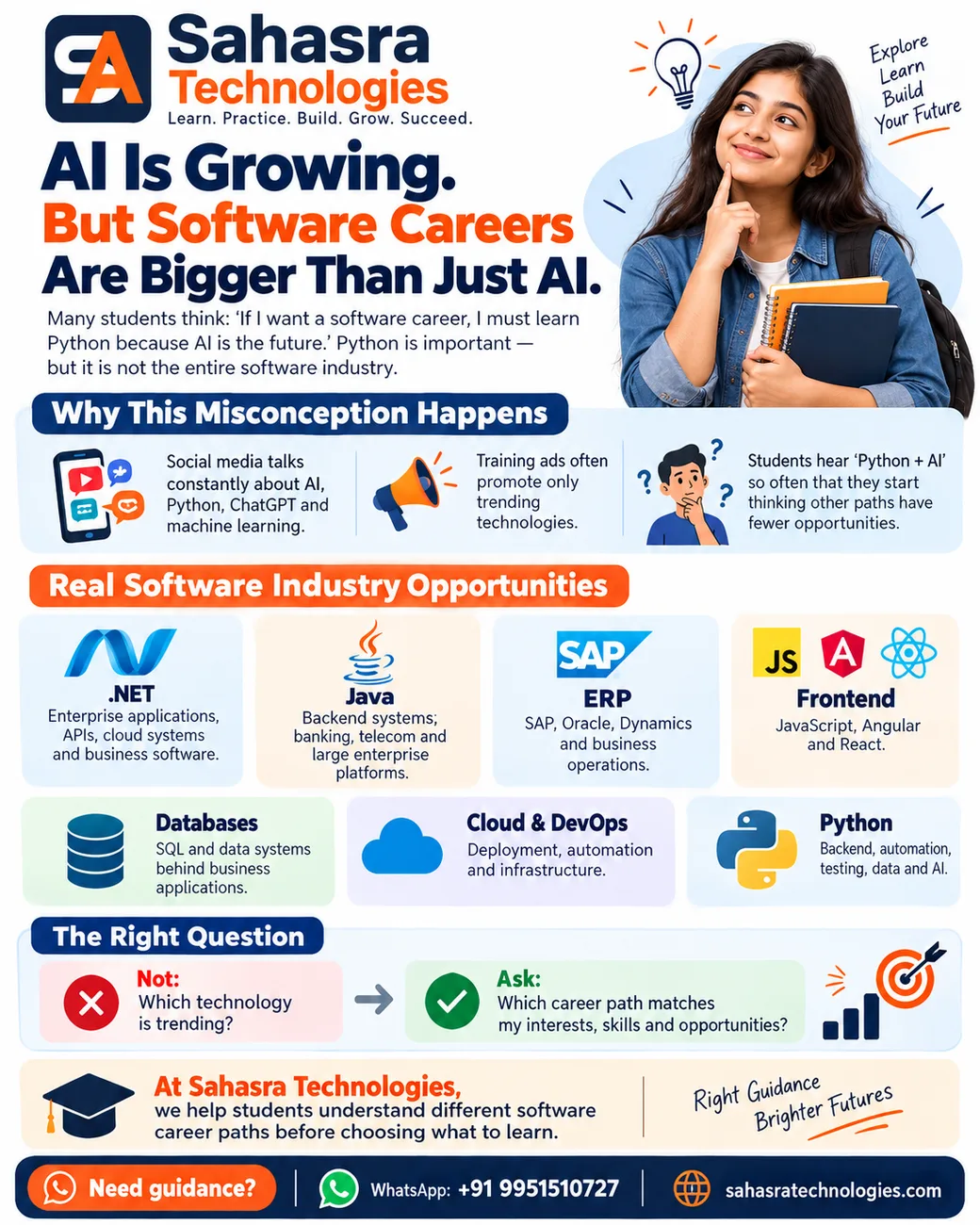
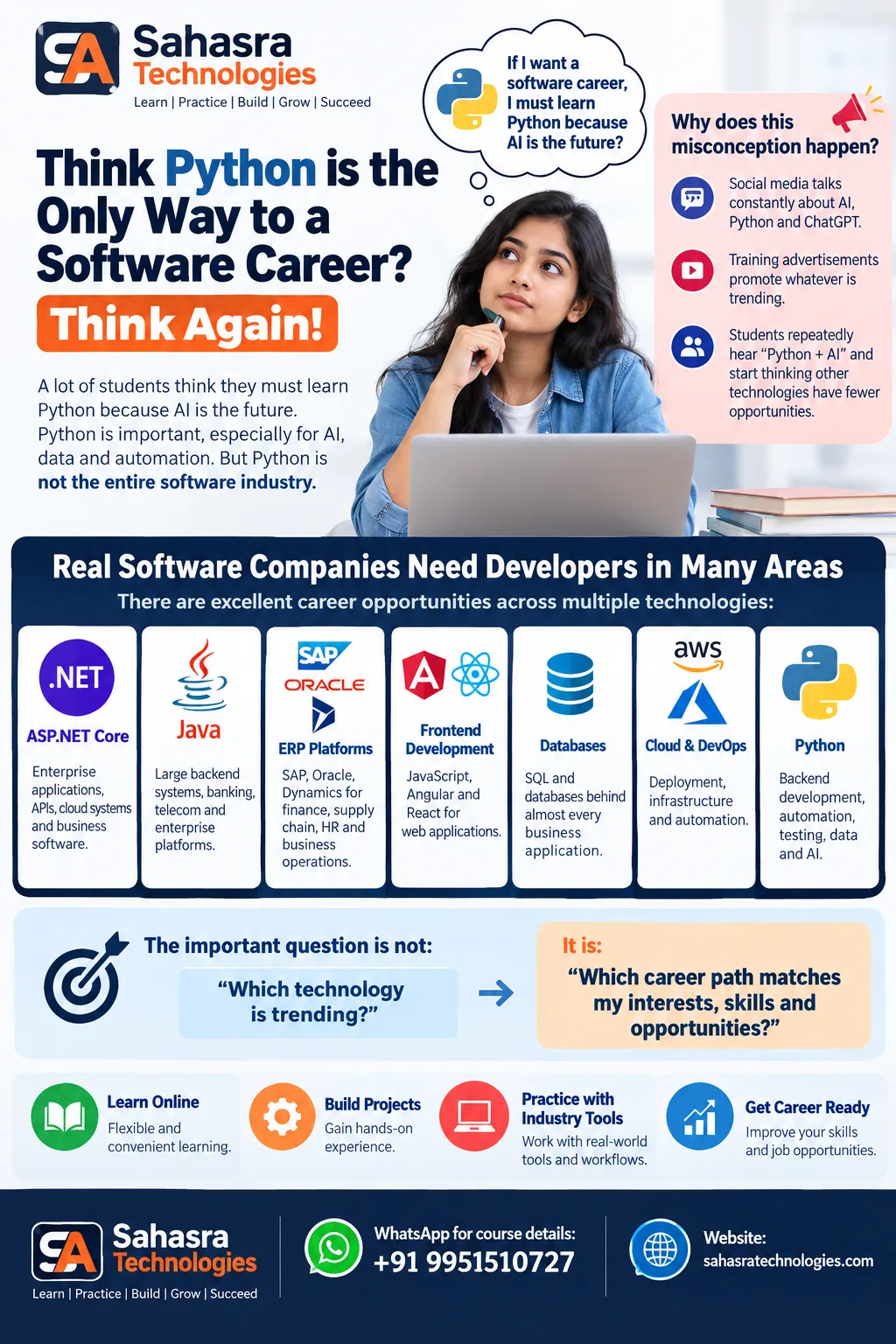
Python Is Not the Only Way Into a Software Career
Python is important for backend development, automation, testing, data and AI. But Python alone does not guarantee a job, and it is only one part of the software industry. Employers recruit for many kinds of software work.
The misconception grows because social media and training advertisements concentrate on AI, Python and ChatGPT. Trends can help you discover a field, but they should not choose your career for you.
.NET
Enterprise applications, APIs, cloud services and business software.
- Example roles
- .NET developer, backend developer, full-stack developer
- Common skills
- C#, ASP.NET Core, SQL Server, Azure, Angular or React
Java
Banking, telecom, large backend systems and enterprise platforms.
- Example roles
- Java developer, backend developer, Android developer
- Common skills
- Java, Spring, Spring Boot, SQL and cloud platforms
ERP platforms
Finance, supply chain, HR, sales and business operations systems.
- Example roles
- ERP consultant, functional consultant, technical consultant
- Common skills
- SAP, Oracle ERP and Microsoft Dynamics 365
Frontend development
Web interfaces, dashboards, portals and customer-facing applications.
- Example roles
- Frontend developer, UI developer, web developer
- Common skills
- HTML, CSS, JavaScript, TypeScript, Angular and React
Data and databases
Application data, reporting, analytics, performance and data operations.
- Example roles
- SQL developer, database developer, data analyst, database administrator
- Common skills
- SQL, SQL Server, Oracle, PostgreSQL, MongoDB and BI tools
Cloud and DevOps
Deployment, infrastructure, monitoring, reliability and automation.
- Example roles
- Cloud engineer, DevOps engineer, platform engineer, site reliability engineer
- Common skills
- Azure, AWS, Linux, Docker, Kubernetes and CI/CD tools
Testing and quality
Product quality, test automation, reliability and release confidence.
- Example roles
- QA engineer, test automation engineer, performance tester
- Common skills
- Manual testing, API testing, Playwright, Selenium and CI tools
Python
Backend services, automation, testing, data engineering and AI/ML.
- Example roles
- Python developer, automation engineer, data engineer, ML engineer
- Common skills
- Python, FastAPI or Django, testing, data libraries and AI frameworks
The better question
Which career path matches my interests, skills and realistic opportunities?
There is no universal “best” technology. Start with a target role, then combine the language, database, framework, tools and project skills that role needs.
- What kind of work interests me: interfaces, business applications, data, infrastructure, testing or AI?
- Which entry-level roles are visible in the locations and companies I can realistically target?
- What complete skill combination does that role require beyond one programming language?
- Can I build, debug and explain a project using that combination?
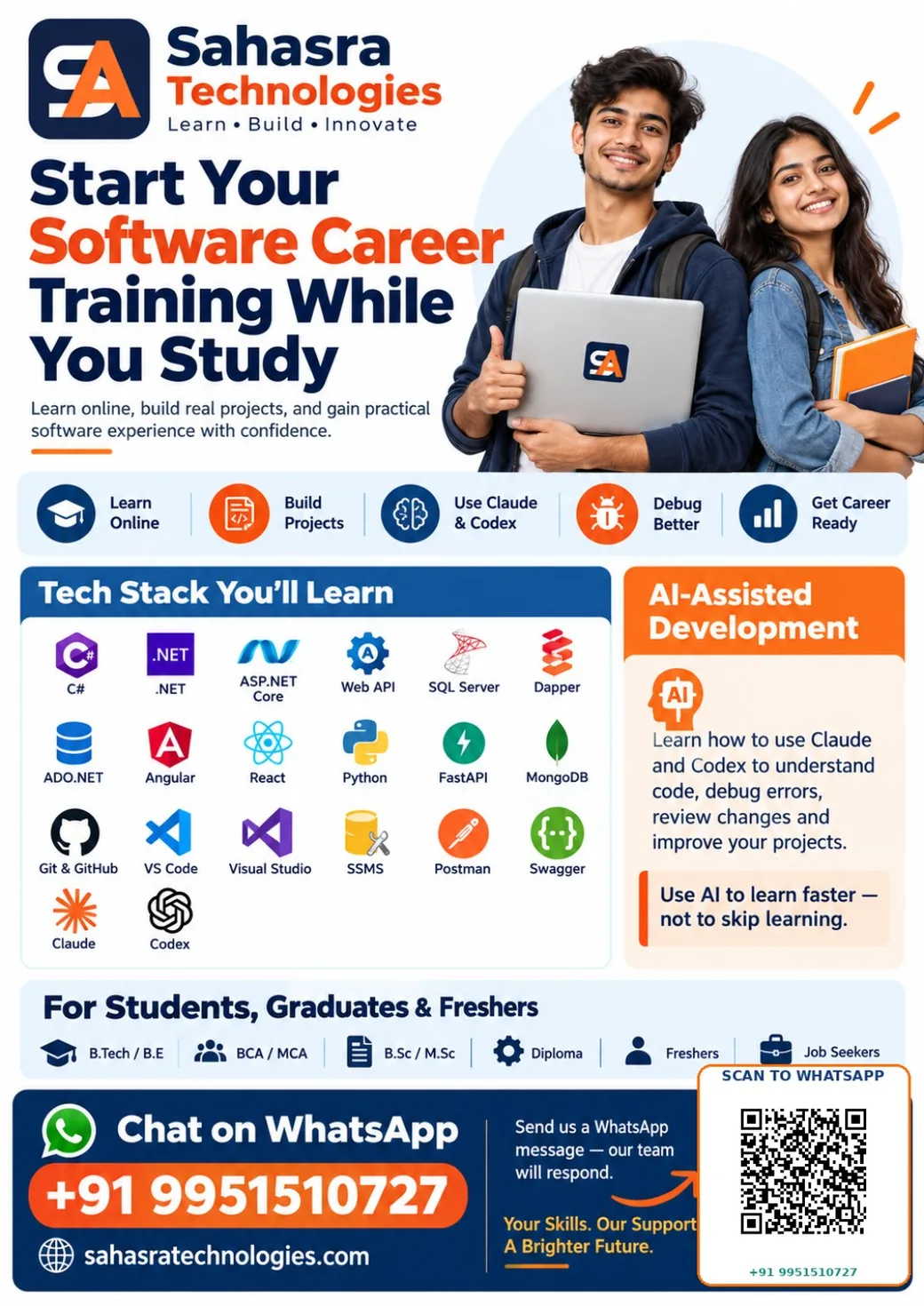
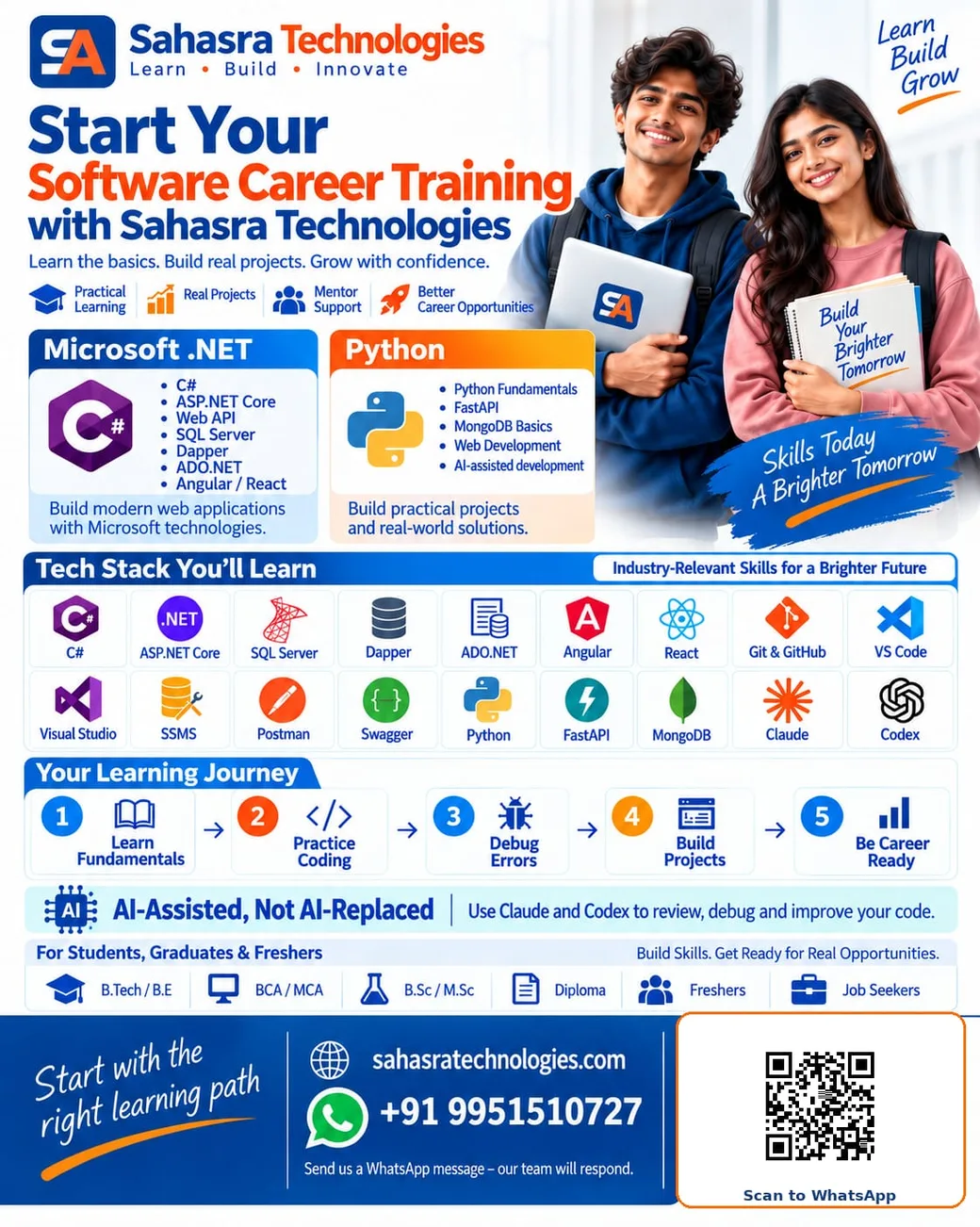
Sahasra Technologies currently provides focused training in Microsoft .NET and Python paths, with supporting frontend, database, Git, debugging and AI-assisted development skills. The wider career map above is guidance — not a claim that every listed technology is taught here or that completing a course guarantees employment.
Industry research
The Work Is Changing. Fundamentals Still Matter.
Figures from published industry research, each linked to its source so you can read the report yourself.
84%
of developers now use or plan to use AI tools in their development process — up from 76% a year earlier.
Stack Overflow Developer Survey, 2025(opens in a new tab)46%
of survey respondents distrust the accuracy of AI output, compared with 33% who trust it. The survey highlights the need for human verification.
Stack Overflow Developer Survey, 2025(opens in a new tab)56%
average wage premium reported in 2024 job advertisements requiring AI skills, compared with similar roles that did not, across the industries PwC analysed.
PwC Global AI Jobs Barometer, 2025(opens in a new tab)39%
of skills required on the job are projected to change by 2030, according to employers surveyed by the World Economic Forum.
World Economic Forum Future of Jobs Report, 2025(opens in a new tab)170M
new roles are projected globally by 2030 while 92 million are displaced, for a projected net increase of 78 million roles.
World Economic Forum Future of Jobs Report, 2025(opens in a new tab)57.5M
developers are projected on GitHub in India by 2030, based on GitHub's forecasting models. This is a platform projection, not a jobs forecast.
GitHub Octoverse, 2025(opens in a new tab)
We do not publish placement percentages, student counts or salary figures of our own. These are global or national industry figures, not outcomes for individual learners.
Roles related to the curriculum
Entry-Level Role Families Connected to These Topics
These examples show how curriculum topics relate to common job titles. Completing a track does not establish eligibility or guarantee an interview.
.NET Developer Trainee
C# fundamentals, ASP.NET Core APIs and SQL Server, applied to a working application.
Related tracks
Frontend Developer
HTML, CSS and JavaScript foundations before a component framework — Angular or React.
Related tracks
Full Stack Developer Trainee
One guided path from language basics to an end-to-end application you can demonstrate.
Related tracks
Database & Backend Support
Relational design, queries and data access with ADO.NET, Dapper or Entity Framework Core.
Related tracks
Python Developer Trainee
Python fundamentals with practical data handling across SQL Server and MongoDB.
Related tracks
Application Support & Maintenance
Reading existing code, reproducing defects, debugging methodically and working with Git.
Related tracks
Career guidance posters
Choosing Your Software Career Path
Python, .NET, Java, frontend, databases, cloud — there is more than one way into software.
Prepare to Present What You Can Do
Build practical evidence, a clearer profile and the confidence to explain your work honestly.